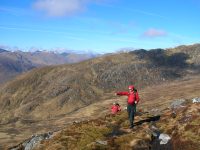
… in DOGstycam GULLEY
Just as the gulley top got tantalisingly close (about 20 metres away) I ran out of rope.
The so-called ‘rock” had led me on for some time looking for runners, through snares and delusions in the form of blind cracks and loose blocks, over too-soft snow, and turf not 100% frozen;- so that the last bit of gear was a long, long, way behind me, somewhere in the vicinity of Loch.
Happily it was moderate ground (solo-ed by many); so I called to Loch to untie the belay and follow me onward.

Catstycam Gulley is about 420 metres up the gulley bed.
We had solo-ed the first half, but then put the rope on as the valley got more distant.

Loch’s response to my call “Are you moving ?” was “Stray Dog” — which is not a recognised Climbing Call.
It transpired that Loch had been approached by a large brown labrador, slipping wildly and with a worried look, followed by a junior member of Fred Karno’s Army in a similar state.
Fred Junior, suggested that
(a) the labrador could be tied to Loch, and that
(b) Fred himself should move ahead, so that he could haul himself up the rope hand over hand if he got stuck. Loch said later that he found this to be “socially delicate”.

Fifty metres ahead, my ankles were getting tired and I could see a promising spike not far away.
I set forth my philosophy that a Second’s primary duty lies towards his Leader, and not to any passing mongrel. (Or the Labrador for that matter). Eventually, we all ended up on the top of Catsycam.
I didn’t take a photo of the dog.
ANDREW


WANNA MEET MY SISTERS ?
On the summit of A’ Ghlas Beinn, Paul and I suddenly swapped a gloomy misty morning for a glorious afternoon.


Two figures came up, and turned out to be girls from Dornoch (but not Sisters) ; whom we’d met for just 5 minutes on Geal Charn the previous winter.

To enjoy the afternoon we headed north to an outlier. A long shoulder of steep ground, facing northwards, now took us on to rock-hard neve.
Out with the axe;- then facing in, then cutting steps;- finally crampons on, as it took us over an hour to get down and across the icy hard slopes.

A useful prelude to meeting the Five Sisters on Sunday. The south-facing slopes were grassy for 2000 feet from valley to ridge:- just as well because it’s
extremely steep ground.
Although the snow cover is only a sliver in the whole view, it was again rock hard, and needed careful going. To our immediate right hand, the north face of the ridge was heavily coated, with some awesome drops.

Crampons were quickly necessary, as was a short spell of downclimbing.
The ridge traverse across 4 snowy summits, adds up to 1500 metres of ascent. However going up can feel straightforward, but there was also 700 metres of descent on steep hard snow; Grade 1 ground, with some unthinkable runouts. The longest was the north side of Sgurr Fhuaran, about 300 metres of snow slope with a deep rock chasm waiting for any slip. After some 3 miles of this, we dropped back out of the snow line and down down down down to Shiel Bridge.

Fortunately the weather was pretty much ideal, sunny, cold, and windless. Five lovely Sisters indeed.

SNOWY HALLSFELL RIDGE
After some significant snowfall over the weekend, Loch and Andrew found Hallsfell Ridge quite well snowed up on Tuesday, (12 Feb) with some sizeable cornices. Possibly the only corner of England that day to sport some brief blue skies and sunshine.


THREE OLD COVES
Two old coves (Loch and Andrew) headed up into Brown Cove (Crag) on Helvellyn on 12th December.. Easy gulley, good neve, excellent views.


GRAMPIAN GLORIES
October 6th and 7th, 2012
“I’m a little Teapot, short and stout…….”

A clear though windy day in early autumn, and a steady pull from Loch Muick up to the summit of Lochnagar at 1155 metres. The last time I was here, had been via the Stuic ridge, seven years before in 2005.
I mentioned Tracey’s little act on the summit cairn, so Matt tried it too. (Frank didn’t).

Lord Byron was not forgotten:-
“England thy beauties are tame and domestic
To one who has roamed over mountains afar
Oh ! for the crags that are wild and majestic
The steep frowning glories of dark Lochnagar”

This was all too much, so off we bounced over another 4 of them thar Munro thingies, to make a big circuit (nearly 20 miles) of Loch Muick, finally ending at Broad Cairn .


After a long day (and a fairly long evening’s refreshment) on Saturday, Matt had a lesser objective for Sunday; the single Munro of An Socach, by its easiest route up the glen from the A93.

It was a peerless morning. The hillsides were thronged with hundreds of Red Deer, all along the 5km of the glen. Being the rutting season, the roaring of stags echoed back and forth down the valley as they competed for this season’s privileges.
Under blue cloudless skies, we made our way to the 944 metre summit, which is a 2km long and almost level ridge.
The views were crystal clear, and with the full Cairngorm panorama spread out to the north, we saw the first snows glittering white on the highest parts of Brieriach and Ben Macdui. To the southeast, Mount Keen, and to the southwest, all the way to Schiehallion.

Although I’ve walked all these hills before, today it was exquisite, and called to mind Queen Victoria:-
“we came upon such a lovely view,
Beinn a’ Ghlo straight before us
…….. but no description can at all do it justice”…………
and no camera could either, unfortunately.
ANDREW

SANDWOOD BAY AND CAPE
WRATH…… SEPTEMBER 2012
The noise.
Like being next to a busy motorway it was thunderous, deep, incessant, and tinged with menace.
In the aftermath of an Atlantic storm, the surf of Sandwood Bay heaved and banged and rolled.
Near to the most northwesterly point of the UK mainland, this remote beach is owned by the John Muir Trust. “Sandwood Bay is among the finest coastal scenery in Europe, with magnificent sands and dune systems, and a landmark sea stack, Am Buachaille, and further miles of wild cliff scenery”
The seaside then, but not as we know it. No habitation, no structures. With the wind whipping in from the west, it was a wild mixture of low clouds, salt spray, sand, and rock. Elemental and inhuman.


Water and wood were difficult, but not impossible. We also got plenty of big stones and put one on top of each tent peg.

Our second day dawned sunny and clear. A joyous walk north for me and my friend Steve Whitehead, into the uninhabited square miles of moorland which becomes the Cape Wrath Firing Range. Heather, grass, streams; and cliffs dropping on our left hand to the still-foaming seas. Deer herds at close quarters. Birds.


Finally the lighthouse. Here is the right-angle of land, the most remote of Britain’s four corners, named (in Old Norse) for the turning-point where Viking ships from Dublin and the Isle of Man would turn east for the homeward leg of their journeys. The most narrow of roads threads its tiny and grass-grown way to the lighthouse, some 12 miles west it comes from a ferry across the Kyle of Durness at Keoldale. Tourists arrive by a minibus from the ferry to see this ultimate point.
Looking east now, we could see another sandy bay between sea stacks, about 4km distant, which holds the single tiny white house of Kearvaig bothy. So it was that in the sunny late afternoon we settled into the comfy bothy, walked the beach, and clambered out to see the stacks.


After the usual 4 courses and uisge beatha (the fabled Glenplatypus of course) we slept well, but not unaware of the growing noise of rain on the roof. 
We left soon in the morning, under grey skies and steady rain.

We’d jettisoned the idea of walking along one of Britain’s highest sea cliffs (Cleit Dubh) in the strong wind and reducing visibility. As the bothy track emerged onto the open moor it got worse and worse. The wind was constant at around 50mph, always pushing, whistling round your head, and driving strong rain in near-horizontal grey sheets across the empty moorland. Hoods well down, wind on our backs, we were glad to have the tiny ribbon of lighthouse road to guide us, and tramped as quickly as we could, to get to shelter.
Eventually the track dropped down to sea level. At the ferry point, the only house was locked and empty. No shelter. No ferry.
The Kyle of Durness is a sea inlet about 600 metres across at the ferry, and 7 km long. The white horses raged across the water, the howling wind pulling long plumes of white spray off them. Obviously the ferry wasn’t coming (he didn’t even answer the phone !) 
So we had to turn south, to make our way around the south end of the Kyle and reach the road.
Easier said than done !!. 800 metres south, an un-named stream, had swollen from its normally-tiny width to a boiling torrent hurling itself down a steep little gorge. Any attempt to cross would result in buckling at the knees and rapidly, a broken head. Heads down, uphill we went directly into the liquid blizzard. After a while, there was a confluence where we were just able to get across the separate strands.
Now came another half hour of contouring south-west, anxiously looking for the next stream which lies a mile away. Finally I saw a stone wall running up the hillside……. and OVER THE TOP of the wall, there appeared the surging, heaving, frightening white water of the Allt Coire Fresgill. This was even more impossible than the previous one !. We tried uphill into the storm for half a mile, but there was no sign of any likely place to cross. The options were now closing in:- I was quite prepared to break a window in the locked house at the ferry IF we could get back ;- however the waters were still rising as the rain poured madly down, and maybe we could not get back across the first stream anyway. The prospect of being trapped between the waters for maybe 2 or 3 days hardly bore contemplation ! The last hope was that Fresgill has (geologically) hurtled so much debris down the hillside, that a small delta has formed at the sea edge. Hardly the Nile, but the torrent levels out and splits into 5 channels. Under necessity, I got across these with the waters just above knee height. Steve followed. Praise be.
Now we ought to be out……… assuming that the footbridge over the Grudie River marked on the map was actually there. Otherwise, we were doubly trapped. Another kilometre along the strand brought us round the corner to the Grudie. This was the daddy of the lot !!. About as wide as a main road, and a huge roaring mass of white water. Was the bridge down ? or surrounded by flood water ?
Deo Gratia, it was there, and we crossed it.
The final “pitch” of this escapade, was yet another stream entering the Kyle. This one was not so steep, and ran smooth and dark. Which meant it was deep. Lying on the bank, I pushed my pole downwards to see if it would touch bottom. It didn’t. Another search began.
Upstream was a wire fence — fortunately sturdy — which crosses the river. I took to this to cross about 3 metres of water which was running 2 metres deep. It swayed and leant !!
And so we escaped. We finally reached the road about 5 miles south of Durness, and having got from where we’d been, we were content to simply ignore the still-pouring rain until a car appeared from the murk to give us a lift !!
ANDREW
There was a young man from Cape Wrath
Who played “submarines” in the bath
He got into trouble
For blowing a bubble
So it’s wise to stay out of his path.
KLETTERSTEIG IN THE TYROL

The suncream came out in the afternoon heat at Munich Airport, where I met York MC’s longest serving expat., Jack Pezzey, now an Australian. However by early evening the Tyrol was resounding to Gotterdammerung as the thunderstorm boomed and cracked and the rain came down in streams. Jack and I had found just 5 days between mutual commitments during his European tour.

We had to dodge the wrath of the Gods (at one point up the mountain in the LamsjochHutte there came an instruction to keep all windows shut and not to touch any taps in the toilets !).
During the non-thunderstorm bits, we were able to climb three “Klettersteig’ routes on different days. You could say it’s German (or Austrian) for “via ferrata”, although there are some differences in character. (There’s also very little current information in English……….). We were concentrating on the Karwendel range, which is part of the Northern Limestone Alps, north of Innsbruck.
BRUNNSTEIN.
A smaller mountain on a misty day. Nevertheless it towers over the Inn valley and has a substantial limestone cliff defending the tiny summit ridge all around. A pleasant hour and a quarter walk through woods to the Brunnsteinhaus Hut. The route goes up from there.

Initially there is an amusing natural cleft in the rock, then follow the wires easily up various ledges and paths. At the odd steeper bit there are a few steel rungs in the rock, or stemples (single steel bars to stand on, projecting from the rock).


There is 1000 feet of this, going up to the summit. (We made it 2000 feet by coming down the same way). The overall “feel” of this is akin to clambering up Jack’s Rake, although whilst I’ve done Jack’s in steady rain, I felt the steel cable was helpful on steep wet limestone. The summit holds a cross, (with gipfelbuch which we duly completed) and a tiny chapel. Mostly, however, the summit ridge is only a metre or so wide. Back at the Brunnsteinhaus we had a well-deserved bier vom fass, before our walk down, and hoped for better weather on the morrow.

MITTENWALDER KLETTERSTEIG

This is a high ridge route, some 5.5 kilometres long, across several jagged summits which form the western outpost of the Karwendel. To quote
“The Mittenwalder Klettersteig is a spectacular scramble following a knife sharp ridge high above the town of Mittenwald. It offers incredible views into the valley of the river Isar to the west and the legendary Karwendeltal (Karwendel Valley) to the east. The ridge’s elevation is in average about 1400 meters / 4600 feet above the riverbed. The ridge as well forms the borderline between Austria (Tyrol) and Germany (Bavaria) From the ridge the climber enjoys also spectacular views into the Karwendel Range and Wetterstein Range. On clear days the Ötztal and Stubai Alps are stretching along the horizon.”
Halfway through a poor morning, but with hope in our hearts, we took the cable car from Mittenwald (about 900 metres) and zoomed up the height of Ben Nevis to the top tourist station at 2244 metres.

From here it’s 15 minutes to the first wires, clip on, and off we go to the Nordlische Linderspitze at 2372 metres. The route leads on over a succession of rocky mountain summits round about 2300 metres, linked by narrow cols, for the next three-and a half miles.
The atmosphere is very similar to Skye Main Ridge, in terms of the narrowness, mainly composed of bare rock, and the constant clambering mile after mile. Yet no route-finding issues…… just follow the steel cable. However an unaided traverse would be very substantially harder than Skye, as there are about 5 major vertical sections, and sundry other awkward traverses with horrific drops. Being Klettersteig, however, there is this friendly cable which you can ignore, hold on to, clip on to, or double clip according to taste.


The vertical sections are of course surmounted with fixed ladders. And naturally, rock steps are equipped with steel rungs or projecting stemples.


In fact at one spot, the route traverses the dizzying east flank of Sulzeklammspitze almost with the intent, one thinks, of taking in a steep natural chimney. Here, each side of the chimney sports stemples for the left foot and right foot alternately, as well as cables either side. !!

The generous protection enabled us to make steady and rapid progress along the ridge, and the wire is ALMOST continuous, except for the odd short walk across an easy col. Except that, after one such place, the resumption of the wire only came on the far side of an old snow gulley. The snow was only a few metres across, but offered 4000 feet of exposure as it swept down into the Karwendel valley. Out with the ice axe. Gently, gently, across.
We crossed the high Klettersteig section itself in about 20 minutes less than the book time of 3 hours, and after a knife-edge finale, we settled down to lunch with some attractive birds.


The afternoon got seriously warm, but it was no cake-walk, as there was 1400 metres of fairly steep descent path to be managed. Happily, a mountain hut halfway down provided a beer and a rest stop.
The Mittelwander is a very secure route, with sensational views and lots of places to enjoy them. Generally there are no real technical difficulties, although we had the ‘out-of-character” exposure at the snow gulley, and early season snow would be more of a problem.

HAIDACHSTELLWAND KLETTERSTEIG
Over at the east side of the range, we took the cable car from the valley of the Achensee to Erfurterhutte. This gives access to a large cirque of mountains, all 5 of which are traversed and connected by klettersteig. About an hour and a couple of km across a rocky limestone hanging valley took us up to the Krahnsattel pass, and the gearing up spot.

The Haidachstellwand (2192m) is a ridge about 1km long. The route climbs the steep northern end, and it is a recently-built route with a much more “sporty”feel than Mittenwald. The route climbs 600 feet altogether, from the saddle to the summit.

Much of this is very steep, at occasional places vertical and maybe slightly overhanging. The effort involved feels like climbing a similar 600 feet at “V.Diff / Severe”, although as we were moving a lot faster than roped climbing , of course with no stops for belaying, there was more of a ‘pumped’ feeling. The local Topo describes the route as having sections graded A, B, and C. (on a scale going to E)

This sportier style of route, required quite a lot more use of rock hand and foot-holds, also hand over hand hauling up the wires. There are no ladders, rungs, or stemples, and the steep parts have small individual metal footsteps the size of a boot sole.

Both of us were carefully using full klettersteig techniques here:- clipping both krabs, and when the going got vertical, I would reach up and clip a wire foot loop overhead, to cut out the possibility of a 4 metre fall down the wire to the previous clamp.
(Obviously a total fall of 5 metres onto a one-metre lanyard would produce a fall factor of 5 in such a case. Remembering that the normal maximum fall factor in roped climbing is 2, it seemed a good idea to avoid much bigger numbers………….)
Towards the upper end, I saw the wire ahead suddenly shoot off rightwards. Pulling over the next rocks……. “ah!, yes, its a wire bridge.” One wire for the feet and one for the hands crossed a very deep gap between two pinnacles. Very Scouting, I thought.

In the hot afternoon, we got on to the grassy summit and signed the gipfelbuch with some sense of merit.
The crossing of the Haidachstellwand is completed by finding a cable at the south end, which is the key to a delightful falling traverse of the last 150 foot cliff. We lingered a little over this excellent finish, as it was also the end of our few short days in the Karwendel.


It’s amazing that the only English guidebook to Klettersteig is now out-of-print, and has not been revised since 1983. A beer at the Erfurterhutte was followed by a good evening meal, and some speculation whether we could get a commission from Cicerone to investigate a couple of dozen more of these routes which are plentiful throughout the German and Austrian Alps.
ANDREW
Here’s an addendum with information, as it is curiously hard to come by. (in English)
The one and only Guide Book in English (it would seem) is the Cicerone “Klettersteig” Guide by Paul Werner. This is a 1987 translation from a 1983 text and is now out of print.
I used this book for the Hindelanger Klettersteig and the Zugspitze in 1999, but it is now incorrect in various places, as routes have changed. (In particular as regards the Seegrube and adjacent Innsbrucker Klettersteig).
There is a very useful video of the Mittelwalder Klettersteig at http://www.youtube.com/watch?v=64bGTAb84mg
plus a detailed account in English at http://www.summitpost.org/mittenwalder-klettersteig/182680
The Achensee Tourist Office gives out a free leaflet about climbing in the area, which includes a topo for the 5 summits in the cirque. This info is also at http://achensee.info/aktivurlaub/sommerurlaub/kletterurlaub/klettersteige
together with some other routes including the Brundertunnel.
I also found (but did not have time to use)
http://www.tyrol.tl/en/sport-offers/climbing-and-mountaineering/
http://www.summitpost.org/goetheweg-trail/302130

FLYING THE FLAG ON FAR-FLUNG FOINAVEN
June 2nd to 5th 2012
Foinaven, Foinaven…… some hill that one !

It’s very big, very rocky, very remote. I had seen the long grey bulk of Foinaven from Ben Hope, and it stood as a compelling objective in the furthest possible northwest reaches of the UK mainland.
Foinaven just misses Munro status by the height of your knees:- conveniently for many, perhaps, because from York it is further away than Paris and if it were a Munro it would be a fairly difficult one, and one of the most prized. We are further north here than Stornoway, and setting aside any quibble from the nearby 801-metre Cranstackie, it’s the 914-metre Foinaven which guards this island’s northwest corner — next stop Iceland !

After 520 miles of driving and a night in a tent north of Ullapool, Matthew, Paul & myself kicked off from lonely Gualin House on the single track road north of the mountain. There’s almost 4km of VERY boggy moorland before you can strike the north-west ridge, so we had ample cause to be thankful that there had been a long spell of unusual dry weather hereabouts. 
A steady chug and some weaving through rock bands brought us to the fore-summit of Ceann Garbh, at which point the ground changed to a barren rocky terrain of shattered pinnacles and plunging screes.

After the graceful curve up to Ganu Mor, we flew the Union Flag to mark the start of the Jubilee weekend.
South of the main summit, the mountain becomes a narrow switchback ridge for another 2.5 kilometres, sometimes only a few feet wide, with steep screes and some cliffs either side, up and down over two or three intermediate summits.


We flew the flag again as the weather was good for it !
The narrow ridge finishes with a 100-metre clamber up a narrow nose, which turns in to a scrambling section near the top.


Around this point, we decided to commit to a traverse of the whole lot, and instead of circling down and back we headed south 4km to Bealach Horn, and the long, long walk out past Lone Farm to the single-track A838. The entire traverse was about 22km and took just over 7.5 hours. Fortunately we didn’t have to walk back a rather greater distance to the car, and many thanks to the young couple who kindly indulged our hitch-hiking !!

After a cool and breezy night on the campsite at Durness, an easy shortish day on Sunday was Ben Hope, (927 metres) – the northernmost “Munro”. Paul had quite taken to toting the Flag by this time, so we’d decided on a new strategy of taking it up all the weekend’s mountains.

By doing a bit extra huffing and puffing, we got to Ben Hope’s summit in 1 hour 57 minutes, giving ample time to take in the superb views (despite the very chilly wind)

Then it was dropping back down and driving a couple of miles to Dun Dornaigil Broch, the substantial remains of an Iron Age stone tower.

Back in Durness, we were welcomed at the Lazy Crofter bunkhouse. Excellent showers !!. Good bit of red wine too, as I remember.
Next up was Ben Loyal, another mountain Paul and I had seen from Tongue last year, and whose craggy castellated skyline just called for an ascent. A somewhat wearying march eventually gave access to the interesting summit tors — sensationally vertical at one point. Hereabouts was the only brief rainshower and mist of our 4 days on the hills.


Time to head south, and for the fourth day we broke our journey in the West Highlands, to take in the Munros of Gleouraich (Mountain of Uproar) and Spidean Mialach (Peak of Lice) which neither Paul nor Matthew had been up before. We camped wild on the shores of Loch Quoich, and whilst taking the customary dram, watched a large round golden moon spring into the velvet sky, clearly mirrored in the still waters.

A lovely evening preceded a lovely early start. Under a cloudless sky we romped up “perhaps the finest stalkers path in the country” [Storer] which made the ascent to the west ridge of Gleouraich feel almost effortless in the cool of the morning.
At the top, our Union Flag finally ended its Odyssey (at least with us) as we left it to fly there and committed its future to the hands of others.

90 minutes or so later, we could just make out the flag from the summit of Spidean Mialach. But by now, time was wearing on past mid-day, and to the south the clouds were gathering. Ben Nevis, some 30 or 40 miles away, was already cloud-capped.
Time for a pork pie, then, and a smart descent. That left us time to enjoy a pint in the sunshine at the Invergarry Hotel, well pleased with 4 fine days and 5 good hills.
But the prince of them all, no doubt about it, had been great grey Foinaven.
ANDREW

SKYE AND STUFF, MAY 2012
SKYE MAY 2012

Maybe there were 22 of us in Sligachan bunkhouse. Maybe not.
It depended on who had come and gone, and who was out very early or very late attempting to cross that there ridge, on the various 3 nights.


Some of us had begun the day before in Glen Shiel, either with Munro-maximisation along the South Glenshiel Ridge, or following the north ridge of Aonach Air Chirith to take in a very pleasant scramble.


There are things on Skye besides the Main Ridge, of course, and these included the Red Cuillin (with its fair share of screes as well as views)

Then there was a scramble in Glen Talisker at Preshal Mor, which was (almost) too steep to take pictures on.
Mike grew an Afro from the volcanic rock.
As always, plenty of wow factor and lots of variety. Wot a nice weekend !
The Snows of Spring….. March and April in the Highlands 2012

After a comfy night at the often-useful GrandTully (bunkhouse with pub attached) the mid-March weather looked decent enough for a trip up the great Craig Megaidth – a long-held objective for Paul who wanted good views from this major mountain.
With Frank and Matt Diggle, Paul and I set off via Coire Ardair to see the huge cliffs.
The ascent ramp to the big notch called The Window was still hard old snow, and crampons were useful despite the easy angle.

Although some freezing mist robbed us of summit views, a grand day followed.


Back across the Window gap, we romped along the ridge over the two more Munros of Stob Poite Coire Ardair and Carn Liath.
It would have been rude afterwards, not to have called to sleep at General Wade’s Meall Garbh bothy, close nearby. Here we found two dogs, a large quantity of alcohol, the most enormous fire, and three greatly-guttural WeeGees. Frank was able to demonstrate his skill next morning, at throwing a ball one way and tricking the dog to run the opposite way.
Munros above Newtonmore followed. Paul and myself made a fine circuit of Carn Dhearg whilst Frank and Matt pursued nearby interests.

The same team re-assembled 4 weeks later in mid-April, objective Ullapool.
From Inverlael, we clambered up Eidiht Clach nan Geala and over Maol nan Caprician.


At this point Frank and I were thinking of how to cook venison steaks in Ullapool Youth Hostel, so we left to get the kettle on, whilst Matt & Paul continued over Cona Meall and Bein Dhearg to make a classic long day.

Sunday dawned bright but was soon hit by strings of mist and showers. The Munro team drove off to tick Ben Wyvis. Feeling only cool about a third or fourth ascent, the Over-Sixties Sunday Morning Club went up Beinn Enaiglair. Only just below Munro height at 889 metres, this interesting and steep Corbett stands at the corner of the Ullapool hills and the route back east. It commands superb views into Torridon, the Fannaichs, and all 360 degrees round.